The Discovery
How Sponge Diving Changed History
Introduction
One object single-handedly shattered the 20th-century myth of linear technological progress. For decades, the academic consensus maintained that humanities technology followed a linear progression, building off itself and slowly becoming more and more advanced. Then the Antikythera Mechanism was found and the disruption that followed shattered these preconceived notions. The mechanism reveals an understanding of complex gear work within Hellenistic engineering that was not surpassed for over a millennium. Its finding forced a total re-evaluation of the capacity of ancient minds to model the universe through precision machinery.
The mechanism manifested the Metonic cycle (19 tropical years/235 synodic months) and the even more precise Callippic cycle, a 76-year period consisting of 940 lunations. Used for astronomical dating by figures such as Hipparchus and Ptolemy, the inclusion of these cycles proves that the Greeks had moved beyond mere observation of the stars. Using fixed gear ratios to simulate mathematical charting of the cosmos.
The Discovery
In 1900 a party of sponge divers from Syme were taken off course and sought refuge near the island Antikythera. Upon exploring the rock shelves 42 meters deep they discovred a 50 meter shipwreck.
This massive vessel speaks to the thriving economy of the Greek Hellenistic society. Divers salvaged what they could, bringing them up piece by piece. Marble statues and trade goods excited archeologists and researchers, making other finds seem less interesting. It was not until 1902 that the bronze pieces of the Antikythera Mechanism would be given closer attention.
After closer inspection Valerios Stais identified the mechanism as a geared device. This discovery was the beginning of a century-long unraveling of our understanding of the historical progression of technology.
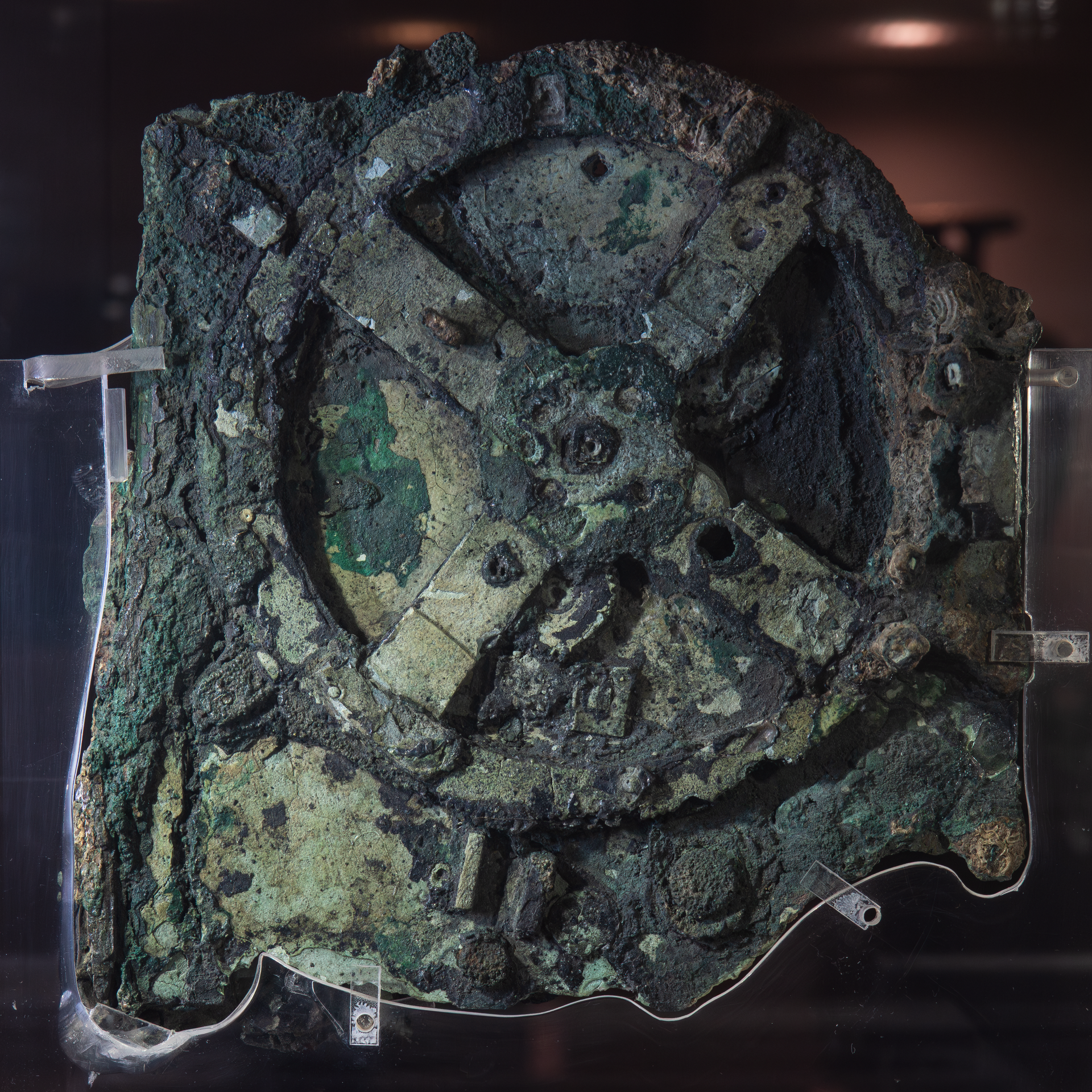
Antikythera Fragment
Historical Disruption
Prior to 1902, the early 20th-century academic consensus viewed the existence of precision gear work in the first century BCE as historically impossible. The device modeled complex astronomical cycles with a precision previously thought to originate in the late Middle Ages. Scholars primarily treated archeological primary sources referencing accounts of complex machines in ancient Greece to be fantastical rather than literal. It was assumed that they had been made up to help make philosophical points within text. The Antikythera Mechanism transformed these suspected fictions into verifiable historical fact.
However, this discovery was not universally accepted at the time. Many scholars were unconvinced by the mechanisms place in history. Additionally, many critics did not believe that the gears were functional or even true gear work at all.
Technological Diruption
The implications of the Antikythera Mechanism extended beyond historical study.
The study of the mechanism’s gear system has been defined by heated debates within the scientific community concerning the reconstruction of the device. Illustrating the struggle of modern academics to reconcile the artifact’s sophistication with their own entrenched frameworks.
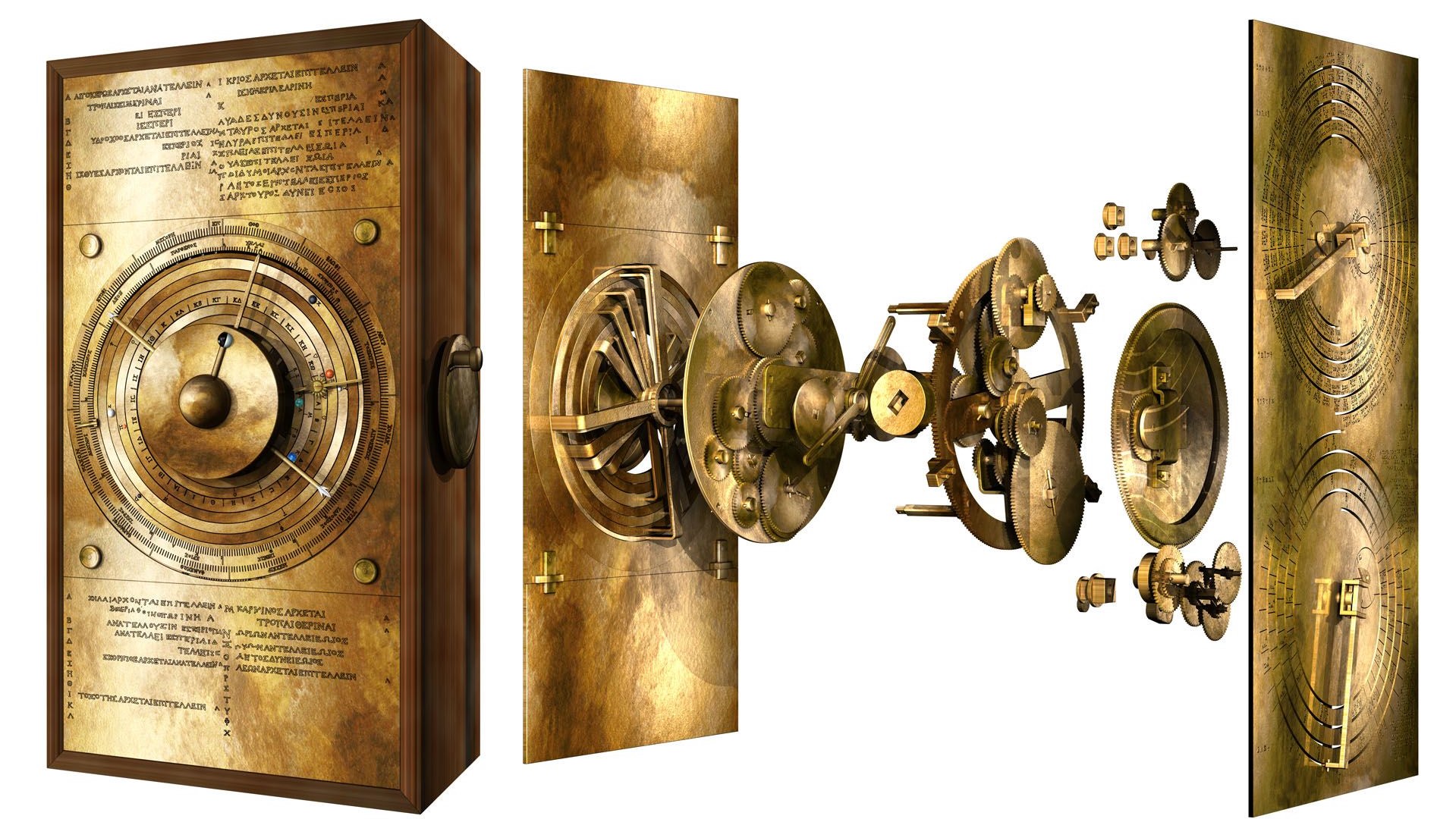
Reconstrution model of the Antikythera orrery
Eras of Reconstruction
The Price Reconstruction (1974): Derek de Solla Price of Yale University popularized the device as an “Ancient Greek Computer”. Utilizing gamma-radiographs, Price proposed a definitive model of the construction in 1974. His most celebrated, and ultimately most controversial, theory was the inclusion of a differential gear system within the mechanism to calculate the synodic month. While conceptually sophisticated, the differential gear’s presence in 80 BCE stunned the scientific community as it suggested an engineering leap of over 1,500 years.
The Wright Refutation (2003–2005): Michael Wright later utilized a home-built tomograph to produce over 700 X-ray images of the fragments. Wright proved that Price’s differential gear was a fabrication of the model rather than a fact of the artifact. He discovered that the problem could be solved more simply using fixed-axle gears and identified a far more elegant solution. Proposing the Greeks used a pin-and-slot mechanism.
Cicero, a Primary Source

As an interal primary account of an orrery in ancient greece Cicero’s De Natura Deorum has helped histroians understand its place in their society and ancient history.
One such example of complex machinery discussed within Grecian history is De natura deorum II. The second book of Marcus Tullius Cicero’s philosophical treatise written in 45 BCE. The artifact vindicated the accounts of Cicero. In De natura deorum II, Cicero describes an orrery constructed by Posidonius of Apamea, whom he visited on Rhodes between 79 and 77 BCE, which reproduced “the same motions of the Sun, the Moon and the five planets that take place in the heavens every day and night” Cicero further references the “craftsmanship of Archimedes” in modeling the revolutions of the firmament. The physical reality of the mechanism proves that these texts were not exaggerations but accurate reports of a sophisticated mechanical tradition.
The Issue With Linear History
The idea that human beings have progressed in a linear fashion does not account for how unreliable our species is. Although many technological advancements have built off one another and progressed from point A to point B there are many aspects of human history that do not. There is so much we don’t know, yet we insist on pretending we do. By insisting on one concrete historical narrative we put ourselves in a box that obscures alternative perspectives.
Ongoing Disruption
Despite being over a century since its discovery, the mechanism remains a dynamic subject of research. A team in 2008 used advanced X-ray tomography to settle the gearing system and confirmed the 223-month Saros cycle on the back dials used for eclipse prediction. However, publication of newly revealed inscriptions proves that the device requires more research attention. It continuously offers new data on the Greek calendars and the socio-political context of its use during the Hellenistic period.
The pin-and-slot discovery represents the earliest known occurrence of a slider-crank mechanism in history. By using a pin on one gear to drive a slot on another slightly offset gear, the Greeks introduced a sinusoidal wave into the gear train’s velocity ratio. This elegantly modeled the way the Moon moves in space, as it appears to speed up and slow down in its orbit.
Additionally, there is evidence of a historical tradition that flowed from the Antikythera mechanism into the Byzantine and Islamic worlds. The Byzantine portable sundial (4th–7th century CE) and the work of al-Biruni in his Book on the Full Comprehensiveness of the Possible Methods for Constructing the Astrolabe (c. 1000 CE) prove that this knowledge was preserved. Al-Biruni described geared calendars using similar mathematical ratios, such as the 7/59 ratio to represent the Age of the Moon, effectively linking Hellenistic technologies to the Islamic Golden Age.
These examples illustrate the ways in which the mechanism continues to alter our perception of the hellenistic period and ancient technology.
Connection to AI
The academic community’s struggle to accept the Antikythera Mechanism’s complexity relates to the modern academic community’s response to Artificial Intelligence. In both cases, experts frequently ignore what they would rather not accept. Illustrating the fear that accompanies being faced with technology that moves what may be possible to what is possible before society is ready to categorize or adapt to it.
Price’s insistence on a flawed model, ignoring Karakalos’s tooth counts to preserve his intellectual framework, mirrors contemporary attempts to minimize AI’s impact by forcing it into existing categories of simple automation. Price’s work gives us a historical warning against algorithmic bias or the forcing of data to fit a modern progress narrative and reminds us of the dangers of cutting corners in the name of answers.
The primary source De natura deorum II discusses those who doubt the way reason guides the universe and gives us a parallel to modern skepticism and doubt about machine intelligence. Just as ancient historical figures struggled to believe a bronze machine could mirror divine reason, modern thinkers often struggle to acknowledge machines that emerge outside expected historical trajectories. The psychological barrier to acknowledging something where it is not expected remains a consistent road block to understanding and accepting new truth or possibilities.
Conclusion
The Antikythera mechanism did not simply add to our knowledge of the past, it disrupted the understood timeline of human progress. It stands as a testament to the ingenuity of hellenistic innovators, combining mathematics and mechanical engineering into a single cohesive representation of the cosmos.
As the mechanism inscriptions demonstrate, the Antikythera mechanism is a living document of human ingenuity. It serves as a reminder that human advancements do not always march forward in a straight line. But are often lost and later rediscovered, reminding us of the true capabilities of our ancestors and what they once achieved.
The legacy of the Antikythera Mechanism is one of continuous disruption. It has proven that representing heavenly bodies with gear systems existed long before it was historically accepted, persisting through Byzantine and Islamic cultures. While we now have a much better understanding of how it works, its most important impact remains the disruption it caused to our understanding of human history. It serves as a permanent reminder that our historical narratives are constantly in flux and we never really know what we think we know.
How I Used AI for This Essay
Explanation will go here.